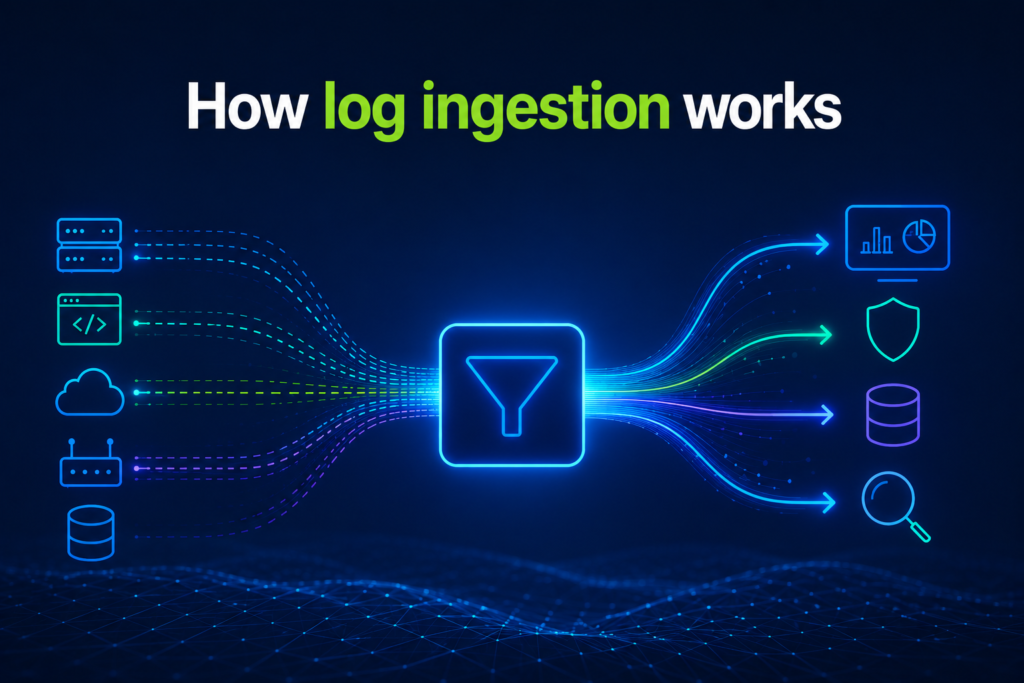
Log ingestion is the process of collecting log data from source systems and delivering it to a storage, analysis, or security platform. It sounds straightforward, moving data from A to B, but in practice it’s one of the most operationally demanding parts of a logging infrastructure.
The difficulty comes from the sheer variety of sources. Every device, application, and service in a modern IT environment generates logs. They use different protocols, formats, authentication methods, and delivery mechanisms. Building a reliable ingestion layer that handles all of them, and continues to do so as the environment evolves, requires ongoing engineering effort.
What Is Log Ingestion
At minimum, log ingestion has three requirements:
- Collection — establishing connectivity between the log source and the ingestion layer. This might mean deploying an agent on a server, configuring a network device to forward Syslog to a collector, setting up an API pull from a cloud service, or consuming data from a message queue.
- Reception — receiving data reliably at whatever rate sources produce it. This includes handling bursts, buffering data when downstream processing is temporarily saturated, and preventing event loss under load.
- Delivery — forwarding the ingested data to its destination without loss and with acceptable latency. For security use cases, latency matters. A log event that arrives at the SIEM tool five minutes after the incident it describes has limited value for real-time detection.
The Real Challenges of Log Ingestion at Scale
- Format heterogeneity — the same environment may include systems emitting Syslog over UDP, JSON over HTTP, SNMP traps, Windows Event Log via WEF, and application-specific formats over proprietary protocols. Each requires a different ingestion path.
- Agent sprawl — the traditional response to format diversity is deploying a different collector or agent for each source type. This works at small scale but becomes unmanageable in large environments, with dozens of agent types, each requiring its own configuration, update cycle, and maintenance.
- Incomplete source coverage — some log sources cannot run an agent, including network appliances, embedded systems, and many cloud services. Others generate logs in formats that standard collectors don’t support. Legacy systems often produce proprietary log formats for which no parser exists.
- Volume and cost management — not all log data is equally valuable. Debug logs, verbose application traces, and routine health-check events can easily dominate ingestion volume while contributing little to security or operational visibility. Without filtering at the log ingestion stage, organizations pay storage and licensing costs for data they never use.
- Reliability under failure — what happens when the destination becomes temporarily unavailable? Unmanaged sources continue writing to local buffers until they fill, then begin dropping events. A robust ingestion layer must buffer, retry, and protect against data loss during outages.
- Compliance and completeness — for audit and compliance purposes, complete log collection is essential. Gaps caused by misconfigured sources, network interruptions, or agent failures can create compliance risks that may only be discovered during an audit.
How Logproxy Handles Log Ingestion
Logproxy’s ingestion model is built around the idea that adding a new log source should not require deploying another agent or writing another parser.
- Format-agnostic reception — Logproxy accepts Syslog (UDP/TCP/TLS), JSON, CEF, GELF, LogFmt, CSV, Protobuf, OTLP, and plain text without manual parser configuration. Most systems can simply redirect their existing log output to Logproxy and begin sending data immediately.
- Autodiscovery — Logproxy can automatically discover log sources in the environment, including servers, applications, network devices, containers, and cloud platforms, and begin collecting data without requiring manual onboarding of each system. This directly addresses the coverage challenges found in large or rapidly changing environments.
- Single agent, multiple source types — rather than deploying separate collectors for different source types, Logproxy acts as a universal agent. One deployment handles diverse log sources, significantly reducing operational overhead.
- Edge processing — ingestion processing happens close to the source rather than in a centralized location. This reduces bandwidth consumption because filtering and compression occur before transmission, while also preventing the ingestion layer from becoming a central bottleneck.
- Volume reduction before delivery — filtering and sampling occur at the Logproxy layer before data reaches the destination. Log events that do not meet relevance criteria are dropped or routed to low-cost storage instead of expensive SIEM storage, directly reducing ingestion costs.
- Flexible deployment — Logproxy runs as a lightweight agent on individual servers, as a centralized collector, as a container, or across Kubernetes environments. It supports on-premises, cloud, and hybrid deployments with high-availability configurations for environments where uninterrupted log collection is critical.
For organizations operating legacy systems that generate logs in formats unsupported by modern tools, Logproxy acts as a translation layer. The legacy system continues logging exactly as it always has, Logproxy receives and converts the data, and the destination receives clean, structured input. No changes to the source system are required.