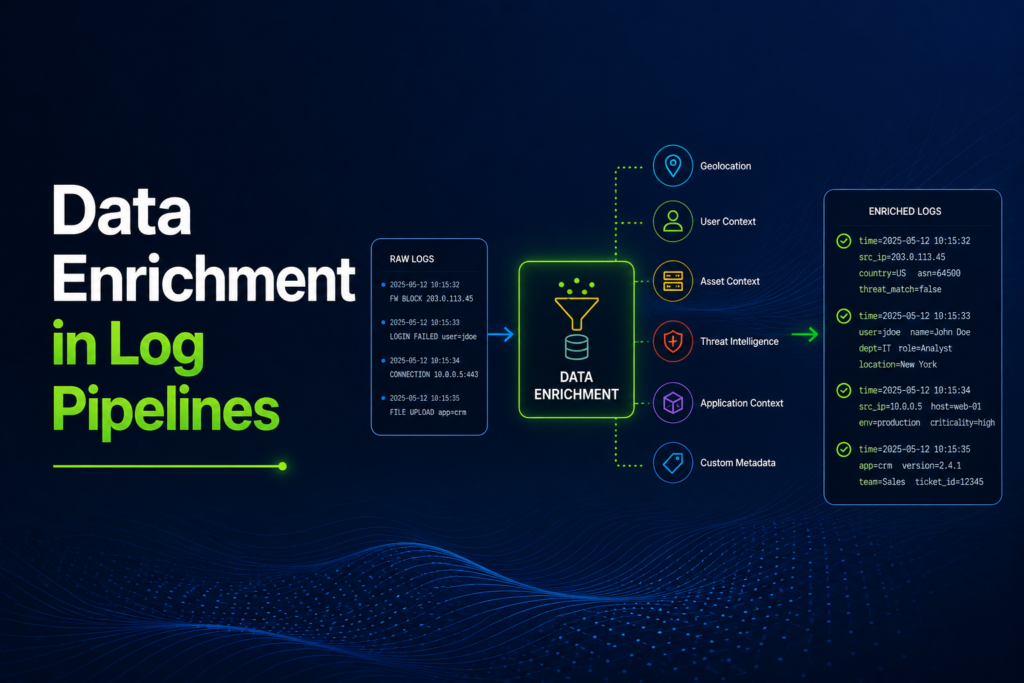
Data enrichment is the process of adding context to log events beyond what the originating system recorded. A firewall log entry contains a source IP address. An enriched firewall log entry also contains the geolocation of that IP, the hostname it resolved to, whether it appears on a threat intelligence list, and which business unit owns the destination system.
The difference matters because context is what turns a raw event into an actionable signal. An analyst looking at an IP address has to run a series of lookups manually to understand what it represents. An analyst looking at an enriched event already has that context attached, so they can investigate rather than research.
What Enrichment Adds to Log Data
The fields added through enrichment fall into a few categories:
- Geolocation — mapping IP addresses to a country, region, city, and ASN. Useful for identifying unexpected access from unusual locations and for geographic filtering in dashboards and alerts.
- User context — mapping user identifiers from logs to human-readable names, departments, roles, or organizational units from an identity directory. A failed login event that shows a username becomes more useful when it also shows the user’s role and normal login location.
- Asset context — mapping hostnames or IP addresses to system type, owner, business criticality, and environment (production vs. staging). An alert involving a critical production server has different urgency than the same alert on a development workstation.
- Threat intelligence — cross-referencing IPs, domains, and file hashes against known threat indicators. An outbound connection to a known C2 IP address reads differently from an outbound connection to an unknown IP.
- Application context — mapping service names or container IDs to human-readable application names, versions, and owning teams. In containerized environments where log sources are ephemeral, this context often isn’t available in the raw log.
- Custom metadata — organization-specific fields that make logs more useful in context, such as ticket IDs, deployment identifiers, and compliance tags.
How Enrichment Works in a Log Pipeline
Data enrichment happens as log events pass through the data pipeline before they reach the destination. Each event is checked against enrichment sources, including lookup tables, external APIs, databases, and static mappings, and matching fields are appended to the event record.
The challenge is doing this at scale without introducing latency. A high-throughput pipeline processing hundreds of thousands of events per second can’t afford a slow lookup for each event. Effective enrichment implementations use local caching of enrichment data, bulk lookups, and asynchronous processing where latency tolerance allows.
Enrichment also needs to be maintained. Geolocation databases update regularly. Threat intelligence feeds change hourly. User directories change as employees join, leave, and change roles. An enrichment layer that pulls stale data is worse than no enrichment because it produces confident but incorrect context.
Benefits of Enriching Data before It Reaches the Destination
- Reduced analyst workload — every manual lookup an analyst doesn’t have to perform saves time. In a SOC handling hundreds of alerts per day, pre-enriched events significantly reduce the time from alert to investigation.
- Better detection rules — alerting rules that reference enriched fields are more precise. A rule that fires on threat_intel_match: true and dst_asset_criticality: high produces far fewer false positives than one that fires on any outbound connection to an unknown IP.
- Cross-source correlation — enrichment creates shared fields across events from different sources. If every log event has a normalized user_id field, regardless of how the source identifies users, correlation queries become much simpler.
- Lower destination costs — some enrichment operations performed at the destination, such as geolocation lookups and threat intelligence checks, are billed per query or require expensive add-on modules. Performing enrichment in the pipeline means the destination receives analysis-ready data, eliminating those per-query costs.
How Logproxy Handles Data Enrichment
Logproxy applies data enrichment as part of pipeline processing before it is forwarded to any destination. The enrichment configuration is managed centrally, providing a single place to define what context is added to which events instead of configuring enrichment separately in each downstream tool.
Supported enrichment types include geolocation, user details, system names, security information, application context, and custom fields. Additional metadata can be added to any log message through the pipeline configuration without modifying the source system or the destination’s ingestion rules.
Because Logproxy processes data at the edge, near the source, enrichment happens before data is transmitted to its destination. This means bandwidth is used efficiently because you’re transmitting enriched, analysis-ready data rather than raw events that require additional processing after arrival.
The practical result is that tools like SIEMs and monitoring platforms receive data that already contains the context they need. Detection rules can reference enriched fields from day one. Dashboards that show geographic distributions or asset breakdowns work immediately rather than requiring post-ingestion enrichment pipelines inside the destination platform.
For organizations using multiple destinations, such as a SIEM, a monitoring platform, and a data lake, enrichment configured once in Logproxy applies to all of them. Each destination receives the same enriched data without needing to replicate the enrichment logic in every tool.