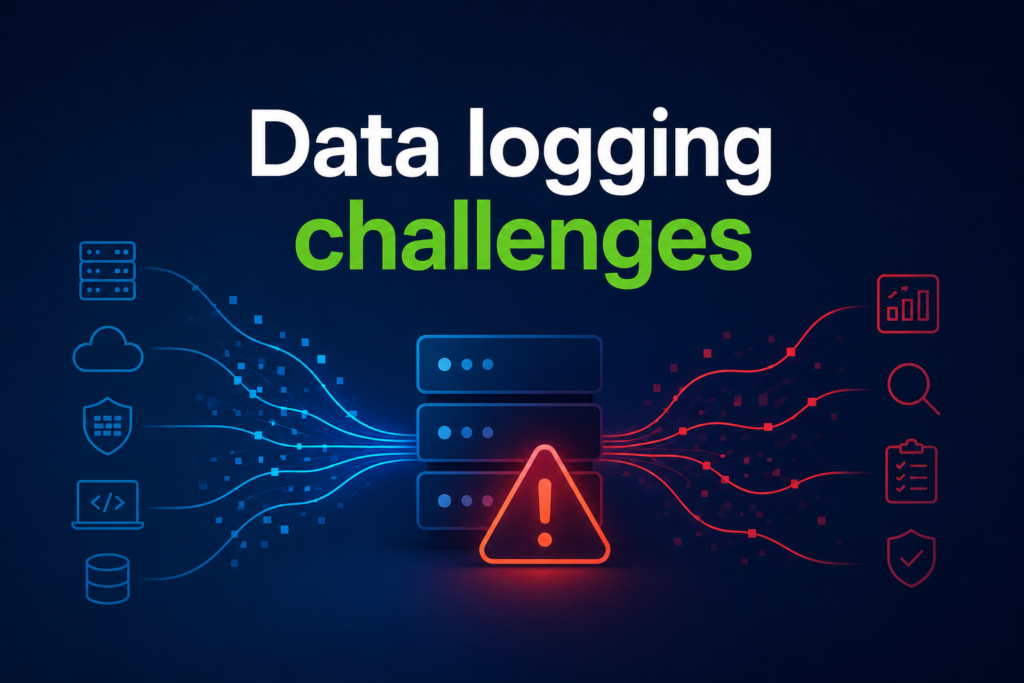
Data logging is the systematic collection, storage, and management of event records generated by IT systems. Every server, application, network device, and cloud service produces a continuous stream of event data, including authentication attempts, configuration changes, errors, network connections, user actions, and system health events. Data logging is the infrastructure that captures this stream, routes it to the right places, and makes it available for security analysis, troubleshooting, compliance, and operational monitoring.
Done well, logging provides complete visibility into what’s happening across an IT environment. Done poorly, which is more common, it creates a fragmented picture full of gaps, inconsistencies, and data that exists but can’t be used efficiently.
How Data Logging Works
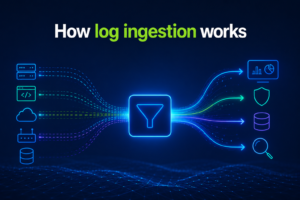
At the source level, every system generates log events according to its own internal logic. An operating system logs authentication events, process activity, and kernel events. A web server logs HTTP requests, errors, and access patterns. A firewall logs connection attempts, policy matches, and traffic flows. A cloud service logs API calls, configuration changes, and billing events.
These events are written to local log files, emitted over network protocols like Syslog, sent to platform-specific log aggregators, or published to message queues. The first challenge of data logging is simply getting all of this data off the source systems and into a central location where it can be stored and analyzed.
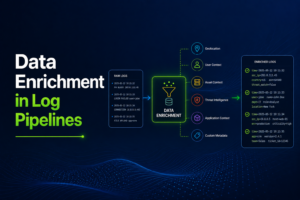
After collection, logs typically pass through several processing stages, including parsing raw text into structured fields, normalizing inconsistent formats, filtering irrelevant events, and enriching records with additional context, before reaching storage and analysis platforms.
The Multi-Vendor Problem
A modern IT environment is almost always a multi-vendor environment. Network infrastructure comes from Cisco, Fortinet, or MikroTik. Servers run Windows or Linux, and often both. Applications are a mix of commercial software, open-source software, and internally developed systems. Security tools include endpoint agents, identity platforms, email gateways, and cloud security services. Cloud workloads run across AWS, Azure, and GCP.
Each of these produces logs differently:
- Different formats — Syslog in multiple vendor-specific dialects, JSON with vendor-specific field names, CEF, proprietary binary formats, and plain text with no consistent structure. What Cisco calls src, Palo Alto calls src_ip, and a Linux system calls source_address. The same IP address, three different field names.
- Different protocols — UDP Syslog, TCP Syslog with TLS, HTTPS webhooks, API polling, SNMP traps, Windows Event Forwarding, Kafka topics, and file tailing. Collecting data from all of these requires either multiple collectors or a single solution that supports them all.
- Different volumes and verbosity — a busy web server may generate millions of log events per day, while a network device might generate only hundreds. A cloud audit log may contain one event for every API call. Managing these at scale requires volume controls that prevent low-value events from overwhelming storage.
- Different compliance requirements — some log sources are mandatory for specific regulatory frameworks. PCI DSS requires payment system logs. SOC 2 requires access logs. Achieving complete, verifiable coverage across required sources, and demonstrating that coverage during an audit, is a compliance requirement rather than simply an operational best practice.
Why Data Logging Breaks Down in Practice
- Coverage gaps — manual onboarding of log sources often leads to incomplete coverage. Systems are added to the environment faster than logging configurations are updated. Legacy systems generate logs that no one configured a collector to receive.
- Parser debt — every source with a non-standard format requires a custom parser. Parsers break when vendors update their log formats. Maintaining a parser library for a heterogeneous environment becomes significant ongoing engineering work.
- Siloed tools — different teams often use different logging tools. Security teams use a SIEM, infrastructure teams use monitoring platforms, and developers use application logging services. Data from the same source becomes fragmented across multiple tools, with no unified view.
- Cost pressure — logging everything is expensive. Most SIEM and log management platforms charge based on the volume of data ingested or stored. Organizations respond by logging less than they should, creating exactly the gaps that matter when an incident occurs.
- Operational brittleness — point-to-point connections between individual log sources and destinations do not scale. Every new source, destination change, or log format update requires reconfiguring individual integrations.
How Logproxy Solves Multi-Vendor Logging Challenges
Logproxy is designed as a universal data logging layer, a vendor-agnostic agent that sits between any log source and any destination, handling the format differences, protocol variations, and routing logic that make multi-vendor environments difficult.
- Format-agnostic ingestion — Logproxy accepts Syslog, JSON, CEF, GELF, LogFmt, CSV, Protobuf, OTLP, and plain text without manual parser configuration. Most systems can begin sending logs to Logproxy without changing how they generate logs. Only the destination address needs to change.
- Automatic source discovery — rather than manually configuring collection for each source, Logproxy automatically discovers log sources in the environment. Servers, applications, network devices, containers, and cloud platforms are identified and onboarded without deploying additional agents.
- Centralized format conversion — format differences between sources and destinations are handled by Logproxy rather than through custom integrations at each end. If a destination expects a specific format, Logproxy converts incoming data accordingly, regardless of the source format.
- Volume control — filtering, sampling, and routing rules determine which data reaches each destination. High-volume, low-value events can be filtered before reaching expensive SIEM storage, while full-fidelity data is routed to low-cost long-term storage for compliance and forensic retention.
- Legacy system support — systems that produce non-standard log formats or cannot support a new agent are handled through Logproxy’s translation layer. No changes to the source system are required.
- Single interface for all sources — instead of managing separate collectors, parsers, and configurations for every source type, everything is managed through Logproxy’s centralized interface. Adding a new source, changing a routing rule, or updating a transformation automatically applies wherever it is needed without modifying individual source systems.
For organizations managing the accumulated complexity of a multi-vendor environment, including legacy systems alongside modern cloud workloads, multiple security and monitoring platforms, and compliance requirements that demand complete log coverage, Logproxy provides the unifying layer that makes comprehensive, maintainable data logging practical.