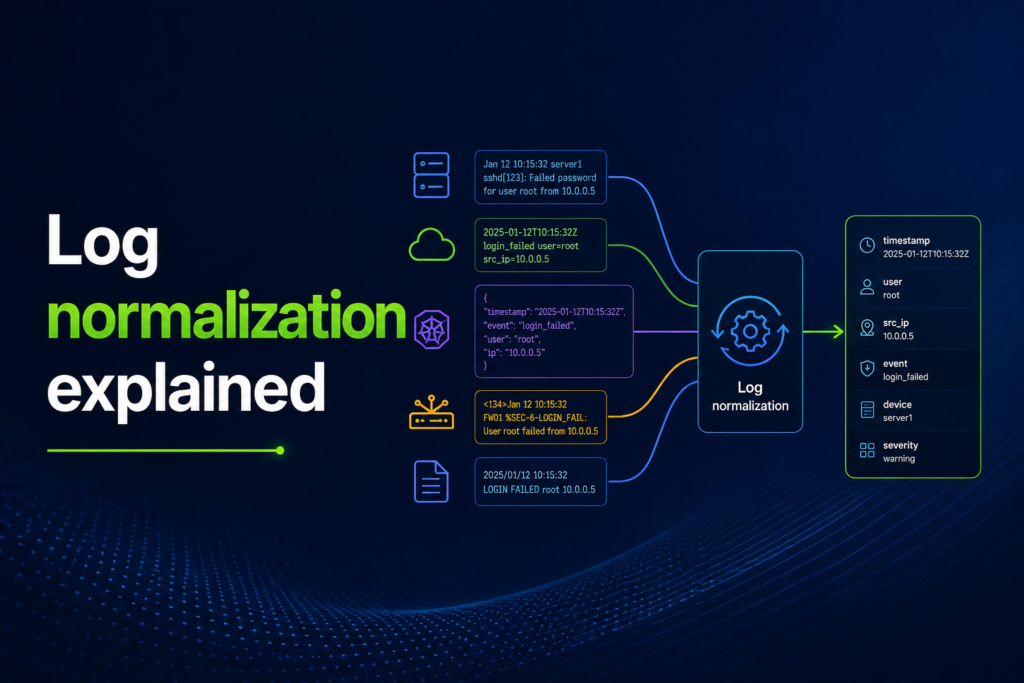
Log normalization is the process of converting log data from multiple sources, each with its own format, field names, and structure, into a consistent, unified schema. The goal is a single format that downstream tools can reliably parse, search, and correlate without needing to account for the quirks of each originating system.
Without normalization, log analysis breaks down fast. A firewall calls the attacker’s IP address src, a web server calls it client_ip, and an endpoint agent calls it source_address. A SIEM system trying to correlate these events during a security incident has to know about all three field names, or it misses the connection entirely.
Why Log Formats Are Inconsistent
Every vendor makes different decisions about how to structure log output. Some use key-value pairs, some use JSON, and some use fixed-width positional formats. Even within a single format standard like syslog, vendors interpret the specification differently and add proprietary extensions.
The main log formats in enterprise environments include:
- Syslog – the most common format for network devices and Unix systems. The base specification is simple, but most implementations extend it in incompatible ways.
- JSON – increasingly common for application logs and cloud services. Field names and nesting structures vary widely across vendors.
- CEF (Common Event Format) – ArcSight’s format, widely adopted by security tools. It has a defined set of core fields but allows vendor-specific extensions.
- GELF (Graylog Extended Log Format) – a structured JSON format used by Graylog and compatible systems.
- LogFmt – key=value pairs, commonly used in Go applications and many cloud-native tools.
- Plain text – unstructured log lines that require parsing before normalization can occur.
A typical enterprise environment runs all of these simultaneously. Adding a new security tool, a new cloud service, or a new network appliance means introducing another format variant.
The Challenges of Normalization at Scale
Field mapping complexity: The same concept, such as source IP, event severity, or timestamp, appears under dozens of different field names across vendors. Maintaining a complete mapping is tedious and error-prone.
Inconsistent timestamps: Log timestamps come in different time zones, precision levels, and formats, including RFC 3339, Unix epoch, and human-readable strings. Correlating events across sources requires converting them to a common reference.
Nested and multi-value fields: Some formats pack multiple values into a single field or use deeply nested JSON structures. Flattening these for indexing without losing information requires careful handling.
Schema evolution: Vendors update their log formats across software versions. A normalization rule that worked last month may silently break after an upgrade, passing malformed data downstream without obvious errors.
Volume: Normalization has to happen at the speed data arrives. In high-throughput environments, a normalization layer that introduces latency or requires batch processing becomes a liability.
The Benefits of Normalized Log Data
When logs from all sources share a consistent schema:
- Correlation becomes reliable. A SIEM can correlate events from a firewall, an endpoint agent, and an identity provider using a shared src_ip field without custom logic for every combination.
- Search is faster and more accurate. Analysts can write queries that apply across all sources rather than maintaining format-specific variants.
- Alerting rules are simpler. A detection rule written against a normalized field works regardless of which source generated the event.
- Ingestion costs decrease. Normalized data typically compresses better and indexes more efficiently than mixed-format raw logs.
How Logproxy Handles Log Normalization
Logproxy performs normalization in real time as data passes through the pipeline before it reaches the destination. This is stream-based processing. Normalization happens on each event as logs arrive, not in batches after the fact.
The log normalization process in Logproxy works at multiple levels:
Format conversion handles the structural layer by converting syslog, JSON, CEF, GELF, LogFmt, CSV, Protobuf, OTLP, and plain text into the schema the destination expects. If a destination requires CEF and the source produces JSON, Logproxy performs the translation without additional tooling.
Field mapping resolves naming inconsistencies. Logproxy maps fields from different source formats to a common schema or to a custom target structure defined for the destination.
Custom target schemas allow organizations to define their own normalized format rather than being constrained by a vendor’s default schema. This is useful when the destination is an internal analytics platform or a data lake with its own field conventions.
Because log normalization happens in the Logproxy layer rather than inside the SIEM or monitoring platform, the destination always receives clean data. It does not need to maintain its own parser library for every source format, and the normalization logic is managed centrally rather than scattered across destination configurations.
For environments with legacy systems that generate non-standard log formats, Logproxy performs the translation without requiring changes to those source systems. The sources continue to generate logs in their existing formats, while Logproxy bridges the gap.