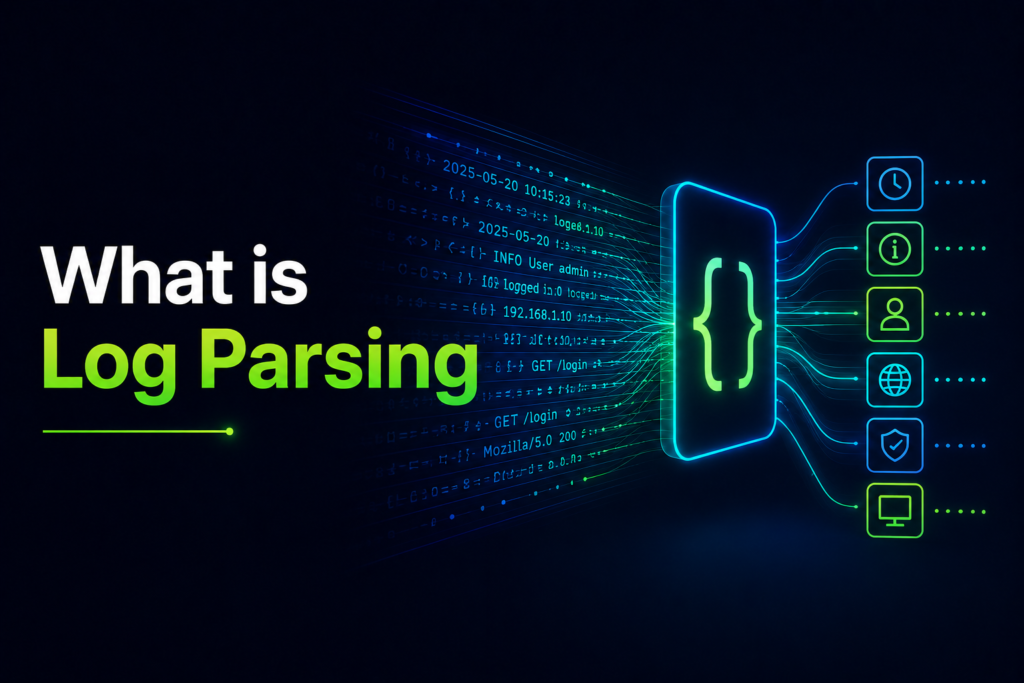
Log parsing is the process of extracting structured, queryable fields from raw log output. A raw log line is just a string of text. A parsed log consists of a set of named fields, such as timestamp, severity, source IP, event type, and username, that a search engine, SIEM, or monitoring tool can index, filter, and use for alerting.
Most log management succeeds or fails based on the quality of parsing. If parsing is incorrect, queries return incomplete results, correlations fail, and alerts miss important events. If parsing is missing entirely for a source, that source’s data is either dropped or stored as unsearchable plaintext.
What parsing actually does
A raw Syslog line might look like this:

After parsing, this becomes a structured record with discrete fields:
timestamp: 2024-06-10T14:23:01,
- host: firewall-01,
- action: BLOCK,
- src_ip: 203.0.113.42,
- dst_ip: 10.0.0.5,
- protocol: TCP,
- dst_port: 22.
The parsed record is indexable. A query for src_ip: 203.0.113.42 AND action: BLOCK works. A detection rule that fires on repeated BLOCK events from the same source IP works. Without parsing, neither does.
Why log parsing matters
Search accuracy — field-level search is orders of magnitude more precise than full-text search against raw log strings. Searching dst_port: 22 returns SSH events. Searching for the string “22” returns everything that happens to contain those characters.
Alerting reliability — detection rules in SIEMs and monitoring tools operate on parsed fields. A rule that fires when failed_logins > 5 in 60 seconds requires a parsed failed_logins field or the ability to identify and count relevant events by type.
Correlation — joining events from different sources, e.g. a firewall block event with an endpoint alert and an identity provider login failure, requires that all three sources have been parsed into compatible field names.
Cost efficiency — most SIEM and log management platforms charge partly based on indexed field count or data volume. Properly parsed and filtered data indexes efficiently. Unstructured data gets indexed as one large text field, consuming more storage for less value.
Where parsing typically breaks down
Parser maintenance overhead — every log source needs a parser. Enterprise environments run dozens or hundreds of distinct sources: network devices, servers, applications, cloud services, security tools, each with their own format. Building parsers takes time. Keeping them up to date as vendors release new versions takes ongoing effort.
Format variations within a source type — even “Syslog” isn’t one format. Cisco devices format Syslog differently from Fortinet. Both differ from how Linux kernels emit Syslog. A parser built for one vendor’s Syslog implementation won’t reliably handle another’s.
Unstructured and semi-structured logs — application logs are often the worst offenders. Developers write log lines in whatever format is convenient. A single application may emit ten different message formats depending on which code path generated the event.
Silent failures — parsing failures often don’t produce obvious errors. A field fails to extract, and the event is stored with a null or missing value. Downstream queries and alerts silently miss those events. This is difficult to catch without active monitoring of parse failure rates.
Schema changes — a vendor releases a new firmware version that changes the log format. The existing parser silently fails on the new format. Depending on how failures are handled, events may be dropped or stored unparsed, and the change may not be noticed until an analyst spots missing data during an investigation.
How Logproxy handles log parsing
Logproxy’s approach is to eliminate the need to write and maintain individual parsers for each source. Its format agnostic ingestion layer handles the structural parsing of known formats, including Syslog, JSON, CEF, GELF, LogFmt, CSV, Protobuf, OTLP, and plain text, automatically and without configuration.
For custom or legacy formats that do not conform to a standard, Logproxy provides field extraction rules that can be defined through a visual interface rather than in code. This covers the common case of proprietary application logs or older systems that predate structured logging conventions.
Because Logproxy sits between sources and destinations, parsing happens in the pipeline before data reaches the SIEM or monitoring platform. The destination does not need its own parser library for each source. Instead, it receives pre parsed, structured data in the format it expects.
This also means that when a source format changes, the fix happens in the Logproxy layer rather than inside the destination platform. A single update to a field extraction rule applies to all destinations that receive data from that source.
For organizations running a mix of modern and legacy systems, this separation of parsing concerns, handled centrally in the pipeline rather than distributed across destination configurations, is what makes the difference between a manageable logging environment and an ongoing maintenance problem.